
I’ve lost count of the number of times I’ve sat in a meeting where personalised learning was used to mean… something. Everyone nodding along like the Churchill dog because it sounds good, but nobody properly asking what it means in practice.
The problem with an umbrella term is that it can make very different practices sound like the same thing. They sit neatly in strategy documents and school improvement plans, signalling good intent without much interrogation. But comfort and clarity aren’t the same thing, and this is where a lot of effort quietly disappears.
So before we go further, here’s the question: if you removed the platforms, dashboards and pathways, would learners still experience teaching that responds to what they actually understand? I’m going to bring us back to this, so hang on and stay with me.
Personalised learning can mean pathways, platforms, dashboards, choice, support, differentiation, adaptive technology or responsive teaching. Some of those things have value, but they are not the same thing, and we need to be clearer about which kind of personalisation we’re actually talking about.
A Term That Outgrew Its Meaning
The original intention behind personalised learning was sound enough. Learners are different, and provision that treats everyone as if they have the same needs, interests, starting points and barriers clearly isn’t going to serve everyone well. In that sense, personalised learning began as a useful pushback against uniformity. It wasn’t really a method, and I don’t think it was ever meant to be. It was more of a direction: a reminder that schools should be responsive to the young people in front of them.
Over time, the label stretched considerably. Personalised learning came to include:
- subject choices and course pathways
- adaptive software platforms
- independent or self-directed study time
- choice-based tasks and projects
- goal setting, reflection, choice boards and learner dashboards
- targeted support and small-group teaching
- differentiated worksheets
- a teacher quietly changing tack because the explanation clearly hasn’t landed
All of those things can, in some broad sense, be described as a response to learner difference, but they are not doing the same job. A pathway is not the same as responsive teaching. A dashboard is not the same as a teacher spotting a misconception. A choice board is not the same as carefully removing a scaffold because a student is ready to think without it.
This is where the umbrella term becomes a bit of a problem. If personalised learning can mean almost anything, then it becomes difficult to evaluate properly and even harder to improve honestly. A school can point to pathways, platforms, dashboards, choice boards and support systems, and it might all look impressively personalised from the outside. The question is whether any of it is actually changing what happens when a learner doesn’t understand something, needs more challenge, or requires a different route into the same ambitious goal.
We need to be more precise. Not because the broad intention is wrong, but because good intentions are not enough to tell us whether something is actually improving learning. A school can look extremely personalised on paper and still be doing very little that helps students learn more, remember more, understand more deeply or become more independent over time.
Three Levels, Not One
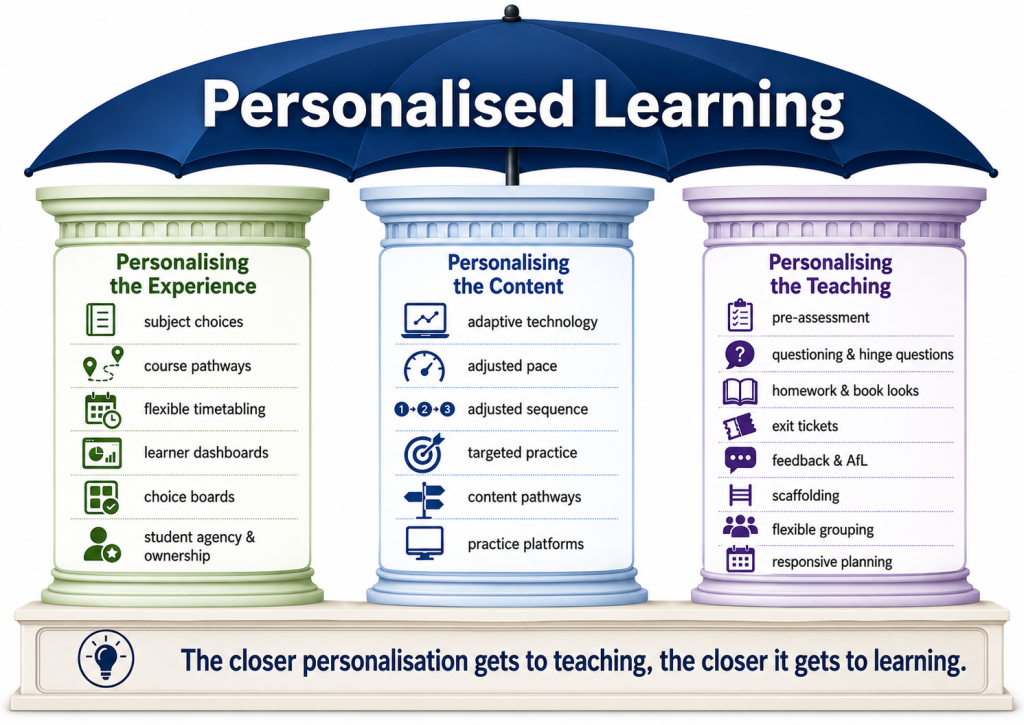
I think a more useful way to talk about personalised learning is to separate it into three levels. The question isn’t just whether something feels personalised, but how close it gets to the actual act of learning. There is personalised, and then there is personalised learning.
The closer we get to the teaching interaction itself, the more likely we are to be talking about something that can actually shift learning.
Level One: Personalising the Experience
This first level is about how schooling is structured. It includes things like subject choices, course pathways, flexible timetabling, learner dashboards and choice boards. Students have more agency over what their educational journey looks like, rather than everyone moving through one fixed route.
I don’t want to dismiss this, because it’s really important in its own way. A student who has real choices about what to study, and some genuine agency over their route through school, is in a different relationship with their education from one who has none. Pathway personalisation can support engagement, motivation and a sense of ownership, and those things aren’t trivial.
Deci and Ryan’s Self-Determination Theory is useful here because autonomy is one of the core needs connected to intrinsic motivation. Giving students real agency over their educational experience isn’t just a nice extra; it can shape how they relate to learning.
But this level still sits around learning rather than inside the teaching itself. A student can have a highly personalised pathway and still experience lessons where misconceptions go unchecked, challenge isn’t responsive, or teaching doesn’t really adjust to what they understand.
So yes, personalising the experience has value, but I don’t think we should confuse it with personalising the teaching. It can create better conditions for learning, but it doesn’t guarantee that the learning itself is being moved forward.
Level Two: Personalising the Content
The second level gets closer to learning because it changes what students practise, the pace they move at, or the sequence of content they meet. This is usually where adaptive platforms come in, with software responding to student answers by adjusting difficulty, offering more practice, or sending students down a slightly different route.
Used well, adaptive technology can be helpful. I’m not anti-technology, and I don’t think we should pretend these platforms have no place. The EEF rates digital technology at around +4 months of additional progress, although that figure is an average across lots of different contexts rather than a promise. It isn’t a magic wand, and it definitely isn’t a reason to buy a shiny platform and assume learning has been sorted.
What I don’t want us to do is confuse adjusted content with responsive teaching. A platform can change the next task, alter the pace, or offer targeted practice, but that is not the same as a teacher noticing why a student is stuck and changing the explanation, model or support. A dashboard can show progress, clicks, confidence scores and completed tasks, but it can’t always tell us whether the student has really understood the idea underneath. It also works better for procedural knowledge.
Differentiated tasks sit awkwardly here too. Many of us were taught that three versions of the worksheet, or activities tiered by perceived ability, were examples of good personalisation. In practice, this often meant lower-attaining students being quietly given the “accessible” route while other students got the richer thinking. We delivered it dutifully because we were told it was good practice, but it often built the ceiling in before the lesson had even started.
Dylan Wiliam’s phrase “lethal mutation” fits here because the intention was never the problem. The intention was to support all learners, but the effect was often to sort them into different destinations. Students on the lower tier rarely moved to the higher tier, and over time the gap widened rather than closed. That isn’t personalisation in any meaningful sense; it’s managed inequality dressed up as support.
The better answer isn’t lower-tier content. It’s keeping the goal ambitious and thinking carefully about the support students need to reach it. That takes us into Level Three, because the most powerful adjustments often come from the teaching, not the platform.
Level Three: Personalising the Teaching
This is the one most directly connected to learning because it’s about how teaching responds to what students actually understand: what learners show through their work, their talk, their questions, their mistakes, and sometimes their silence and confused little faces.
Teachers gather this in all sorts of ways. Some of it comes before the lesson, through pre-assessment, previous assessments, homework, book looks or patterns from earlier teaching. Some of it comes during the lesson, through questioning, mini-whiteboards, hinge questions, student talk and the things teachers notice while circulating the room, where we can respond in real time as often as possible. Some of it comes afterwards, through exit tickets, marking, assessments, student reflections or the work students produce when the support has been taken away; that’s where it should feed into planning.
The point is not to collect all of this because we like having more information (although, I’ve met a few with a weird inclination towards hoarding and harvesting pointless data!). If a pre-assessment shows that half the class already understands the starting point, the plan probably needs to change. If book looks show the same misconception appearing again and again, something needs reteaching. If an exit ticket shows that students could complete the task but can’t explain the idea, we need to plan to address it.
Assessment for Learning only matters if it changes the teaching. Teachers know this, but it’s still very easy for schools to drift into collecting evidence of understanding rather than responding to it. Black and Wiliam’s work brings the conversation back to action: assessment is only formative when it shapes what happens next. We spot the problem, then we actually do something about it.
Feedback has the same problem if it doesn’t lead to action. The EEF rates feedback highly, but it has to be timely, specific and focused on what the learner should do next. Students also need the chance to act on it, which is why feedback literacy needs to be taught explicitly rather than hoped into existence.
Metacognition and self-regulation only fit here when they’re taught properly. Giving students reflection time is not the same as teaching them how to plan, monitor and evaluate their learning. Some students can and will work that out for themselves, because some students always do, but relying on that is not personalisation; it’s just hoping the right students will somehow get there.
Rosenshine’s Principles of Instruction are useful because they focus on the habits that make responsive teaching possible.
- reviewing prior learning before introducing new content
- presenting new material in small, manageable steps
- asking questions and checking responses from all students
- providing models and guided practice before expecting students to work independently
- using scaffolds for difficult tasks and removing them as students become more secure
This kind of personalisation is usually the least shiny version, which is probably why it gets less attention than platforms, pathways and dashboards. It’s also harder to package, sell or monitor, which matters in education more than we sometimes like to admit. Most of the time, it looks like well-planned teaching, close attention and sensible adjustments from a teacher who knows the curriculum well enough to respond without lowering the bar.
That might mean:
- pre-assessment used to check starting points and likely misconceptions
- questioning that helps the teacher decide whether to move on, pause or reteach
- homework and book looks informing future planning, not just checking compliance
- exit tickets used to decide what needs revisiting
- feedback that students have time to act on
- scaffolds added, adjusted or removed as understanding changes
- flexible grouping used temporarily when students need different support with the same ambitious goal
- student reflection used carefully, so learners are taught how to understand feedback and make better decisions
If all that gets collected and nothing changes, we haven’t personalised the teaching; we’ve just gathered more information, and schools already have quite enough of that.
This doesn’t mean thirty different lesson plans, a classroom where everyone is doing something different, or a teacher trying to personalise themselves into the ground. It means knowing the intended learning clearly enough to adjust the route without quietly lowering the destination.
At its most effective, personalised learning isn’t something layered on top of teaching. It comes from the quality of the teaching itself.
Why I’m Being Fussy About the Difference
Pathways, platforms and dashboards can absolutely have a place. Pathway personalisation can give students more ownership over their route through school, and well-designed adaptive technology can provide targeted practice that supports the work teachers are already doing.
The mistake is treating all forms of personalisation as though they are equally close to learning. A school can have:
- elaborate learner dashboards
- extensive course choice
- sophisticated adaptive platforms
- flexible pathways and support systems
and still not be personalising learning in the way that most directly changes what students understand. The visible structures may create better conditions for personalisation, but they do not replace teaching that responds to what students have shown.
I said I’d bring us back to the question from the beginning, so here we are: if you removed the platforms, dashboards and pathways, would learners still experience teaching that responds to what they actually understand?
The answer tells us a lot. If learners would still experience responsive teaching without those structures, then the systems may well be supporting something real. If they wouldn’t, then the school may have built the conditions for personalisation without quite reaching the thing itself.
Personalisation that is visible in a strategy document but invisible in a lesson is not really personalised learning. It is personalised administration, and that is a very different thing.
Discover more from Edu'Flections
Subscribe to get the latest posts sent to your email.